levelsio on X wrote a provocative tweet yesterday on the future of websites:
Sure but realistically websites are probably a thing of the past in a few years
— @levelsio (@levelsio) April 13, 2026
Everyone will just use whatever interactive calculator their AI chat app spins up for them, or it will just answer whatever calculation question they have
They won't need a website for it https://t.co/aYds5pbYbe
I work on the Microsoft Store and I’m invested in web platform standards. I think a lot about the future of apps and the web.
Will all that I know and love and work on soon be wiped out and replaced by the new AI thing? ☠️
In the future, why use websites? Just use AI to answer questions.
In the future, why use apps? Just use AI to open your garage door, listen to that podcast, translate that sentence, make a video call, summarize latest posts from the creators you follow.
AI becomes the everything app.
This is a pretty hot take. Yet, there might be some truth here as I examine my own tech usage and notice trends among family and friends:
- I’m using search engines less. Instead of searching and sifting through links, I just ask an AI chatbot and get a direct answer. I’ll fallback to search engines only if I don’t trust the AI’s answer.
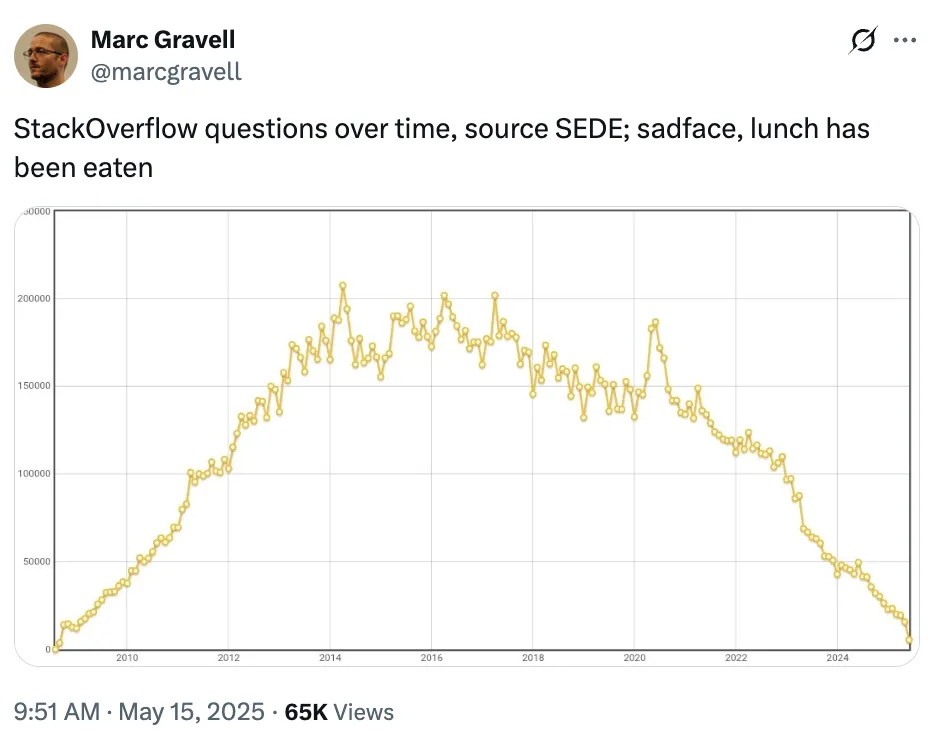
- I’m using websites less. Why browse StackOverflow when I can just ask AI my question?
- I want to use apps less. Instead of downloading, installing, and launching my garage door opener app, I just want to tell my garage door to open. Today that requires an app and/or a custom piece of hardware: a garage door opener! 😅. But it doesn’t need to include either of those things. I don’t want to use a custom piece of hardware or a custom app. I just want to tell my garage door to open. AI can do this in the future.
- I’m already using AI for things previously only apps and websites did. For example, I’m learning the Hebrew language, and instead of using Google Translate on the web or the app on my phone, I just ask AI to translate or clarify terms and phrases. I’m using AI to help me write software, no longer relying on search engines, API docs, blogs, e-books, or tutorials. I’m using AI to give me dinner ideas and recipes when cooking for my family.
Using websites less
I suspect the trend to use search engines less is a strong, broad trend that will be widely adopted as years go by. Older people will still use search engines, but young people who haven’t been trained in the old ways will just use the easiest path to find information. From my vantage point, that looks to be AI chat bots.
Chat bots are easier to use than search engines.
- With search engines, you type a query, get some ads, hunt and peck through the results, with each result opening a new context.
- With chat bots, you type your query, get zero ads (for now), and get a direct answer to your question. It is a step towards the Star Trek future of communicating with computers in natural language.
If search engine use declines, websites will follow.
Why post on websites when no one will find you? Already, the web has become a wild west of malware, crypto scams, ad farms, content spam, SEO link boosters. The number of genuinely useful sites are decreasing because the eyeballs aren’t there; they’ve migrated to social media. Few people will read this post on the open web because everyone’s spending most of their time on social media and video shorts. (I’m guilty of this too.)
I’m noticing this trend in younger people. My kids don’t understand what a web browser is. They use just use social media apps, games, and increasingly AI.
This trend will accelerate as search engine traffic declines. There will be increasingly fewer reasons to post content to websites when the eyeballs are elsewhere.
This is a bit of a sad state, but seems to me a likely outcome. The web is the single repository of all human knowledge, but AI has already consumed it and can regurgitate it in nice, succinct answers in your AI chat bot.
Using apps less
The mobile platform shift resulted in people using apps more.
Apps are (theoretically) different from websites, in that they give you privileged access to your device hardware. My watch has an app that monitors my heartrate. My phone has an app that can made video calls.
The mobile platform shift resulted in apps becoming more important than websites.
The AI platform shift will result in chatbots becoming more important than apps.
And really, chatbots is not the right mental model; it’s too limited. Future use of AI won’t just be chat. AI agents could generate apps on the fly, creating UI to do whatever task you need. Some apps, like home security apps, will work with text or UI created on the fly: you could ask your AI if your frontdoor is locked (chat) or you could view your home security camera (UI created on the fly for you with video feed and playback controls).
What would it take to completely replace apps and websites?
I don’t think AI will completely replace apps, just as mobile apps didn’t completely replace websites.
But with this platform shift, there will be fewer reasons to build apps and websites.
A likely future direction for software development will be AI connectors. If you build home security systems, you’ll build connectors (MCP servers?) that will securely allow AIs to control a user’s home security system. If you build a podcast platform, you’ll build connectors that allow AI agents to browse and play podcasts. If you build email or chat, you’ll build connectors that allow AI to chat with a user’s contacts.
This trend will be resisted by companies and platforms for economic reasons. Social media companies won’t want to build connectors for AI agents because they need you to use their website/app so they can show you ads. The home security company won’t want to build AI connectors for your home security system, because the want you to use their app so they can upsell you on new home security devices.
The economic answer for this, then, is some sort of contract between the AI and the connector, where the connector requires the AI to display ads. Facebook, X, TikTok and others would build AI connectors if the contract for the connector said, “Any time you interact with our service, you must show one of our ads N% of the time.”
This would incentivize platforms to build connectors for AIs.
Websites should still exist.
I don’t want the web to disappear. AI wouldn’t exist without the web. The web still matters.
Especially for creators. The web allows creators to publish without approval, create without gatekeepers. It allows creators to own their own content. Websites matter, the web still matters.
But will users see it? In a world where human interaction with computers is mostly or even entirely via AI agents, it’s not clear to me how eyeballs will get on that content. Your grandchildren will talk to AIs, not browse the web. Your greatgrandchildren will use AI agents to do the thing, they won’t use apps.
It seems, then, there’s a need for a creator -> AI consumption pipeline. Maybe that’s still the web: the AI will continuously crawl the web for new content.